
Government

Security systems for municipalities and government facilities

JK Quality designs and integrates video surveillance, access control, intrusion detection and AI-powered safety solutions for municipal buildings, public agencies and infrastructure sites across Canada. We plan systems around public access, privacy requirements and each facility’s operations.
Government facility security solutions
jk graphic right

The challenges

Security challenges facing government and public-sector facilities

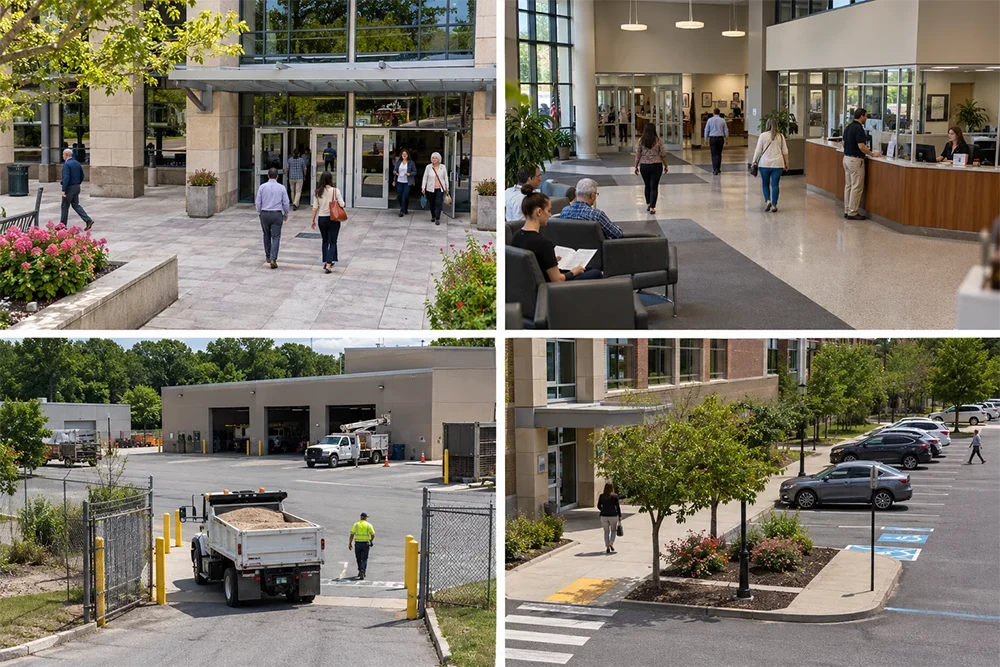
A municipality operates offices, public counters, arenas, libraries, works yards and unstaffed utility sites. Municipal security systems apply one standard across all of them.

  • Public access and after-hours security: City halls, service counters, libraries and community centres are open to anyone during the day. After hours they need controlled access and intrusion detection, with schedules that change for council meetings, programs and rentals. JK configures access control and alarm schedules that follow each facility’s calendar, so every building is open and secured at the right times.
  • Security across municipal departments: Facilities, parks and recreation, public works, transit and IT each have their own buildings and their own needs. A shared platform with department-level permissions avoids a different system in every building. JK sets up that shared platform, and a central alert dashboard brings alerts from every department into one place.
  • Unstaffed and remote sites: Works yards, salt domes, pumping stations and water facilities often have no one on site. These locations rely on intrusion detection and video with alerts. JK installs both, adds loitering detection and licence plate recognition for yards and gates, and uses camera quality assurance to confirm that each remote camera keeps a clear view.
Read More Read Less
  • Privacy and records obligations: Public bodies are subject to provincial privacy and freedom-of-information legislation, such as MFIPPA in Ontario. Video retention, access to footage and response to records requests all have to follow policy. JK configures retention and user permissions to match that policy, and secure, encrypted video sharing delivers footage when it must be released.
  • Procurement and documentation: Public purchases go through RFPs, approved-vendor lists and council reporting. Buyers need a Canadian supplier who can provide complete design documentation, commissioning records and support terms that fit a multi-year budget cycle. JK provides each of these as part of every project.
  • Public safety and liability: Public buildings see falls, blocked exits and repeat trespassers like any other busy facility. JK integrates fall detection, blocked-exit detection and facial matching so designated staff are alerted to each, and environmental sensors add air quality and noise alerts in washrooms and other camera-free areas.

Our Solutions

What we integrate for municipalities and public facilities

JK integrates video surveillance, access control and intrusion detection for public-facing buildings, municipal departments and unstaffed sites. Supporting technologies can extend visibility, incident review and safety alerts where approved and compatible with your infrastructure.

Video Surveillance & AI

We install cameras at public entrances, service counters, parking areas, yards and remote sites, managed centrally with department-level viewing permissions. AI-powered alerts can flag after-hours activity at a yard or utility site. Retention is set to match the municipality’s records policy. Camera quality assurance compares each camera’s clarity against its original baseline and reports blocked, out-of-focus or shifted views on a schedule you set.


Explore Video Surveillance & AI ↗

Access Control & License Plate Recognition

We configure credentials and schedules across every department and building from one system, with public and staff zones defined per facility. Doors follow the program calendar, and an audit trail shows who entered where and when. Credentials for departed staff and contractors are removed in the system. Licence plate recognition manages vehicle access at gates and staff lots and logs visitor vehicles.


Explore Access Control ↗

Alarm & Intrusion

We integrate intrusion detection for buildings after hours and for unstaffed sites at all hours, with alerts routed to the facilities or security contacts the municipality designates. A central alert dashboard brings alerts from every building and site into one place.


Explore Alarm & Intrusion ↗


Loitering Alerts and Video Search

We configure loitering detection for building entrances, parking areas and yards, with dwell-time thresholds set by zone and instant alerts that include video. Event classification sorts alerts as they occur and lets staff search recorded video to find the footage they need in seconds.

Facial Matching and Secure Video Sharing

We integrate facial matching so designated staff are notified when a person of interest, such as someone with a trespass notice, enters a building. The same facial matching can grant or deny access at controlled doors. Secure, encrypted video sharing delivers footage to police and authorized staff.

Safety, Compliance and Health

We integrate blocked-exit and clearance detection to alert staff when emergency exits, fire extinguisher locations or electrical panels are blocked. Fall detection alerts staff when someone falls and secures the video as evidence. Environmental sensors alert staff to vaping, air quality issues and unusual noise in camera-free areas such as washrooms.

Services & support

How JK works with schools and school boards

JK designs systems for school buildings, plans installation around school activities and supports the equipment over time. Our team works with facilities staff throughout the process.

01

Assess

We assess the buildings in scope with facilities staff and the department leads who use them, and we review any existing systems so the design builds on what already works.

02

Design & Integrate

We produce a design that can be applied across departments and buildings, with the drawings, equipment schedules and specifications that procurement and council reporting require.

03

Install & Commission

Rollouts are planned around budget years and building schedules, so a municipality can start with the highest-priority sites and extend the same standard over time. Each phase is commissioned, tested and handed over with records.

04

Support

Public systems are expected to last. JK maintains, troubleshoots and updates the system for the long term, with support terms that can be written into the contract.

TAKE THE NEXT STEP

One security standard across every municipal facility

Whether you are scoping a single building or an RFP across departments, tell us what is in scope and we will recommend a system and a rollout that fits.
jk graphic right

Helpful answers

Frequently asked questions about municipal and government security systems

What security systems do municipalities use?

Most municipalities combine video surveillance at public buildings, yards and remote sites; access control for staff and public zones across departments; and intrusion detection for after-hours and unstaffed locations. Many add AI-powered software such as loitering detection, license plate recognition and obstruction detection. Managing everything from one platform keeps the standard consistent across buildings.

How do public institutions handle video surveillance and privacy?

Public bodies follow provincial privacy and freedom-of-information legislation, such as MFIPPA in Ontario. In practice that means a written policy on where cameras are placed, how long video is kept and who can view or release it. JK configures retention and user permissions to match that policy during commissioning.

Can one access control system cover multiple municipal buildings?

Yes. One access control system can manage credentials, schedules and audit trails across city hall, community centres, libraries and works yards, with each department seeing only its own facilities. New buildings are added to the same system.

How are unstaffed sites like works yards and pumping stations secured?

Unstaffed sites rely on intrusion detection and video with alerts that tell designated facilities or security contacts about activity as it happens. Footage is available remotely, so the site can be checked from anywhere.